
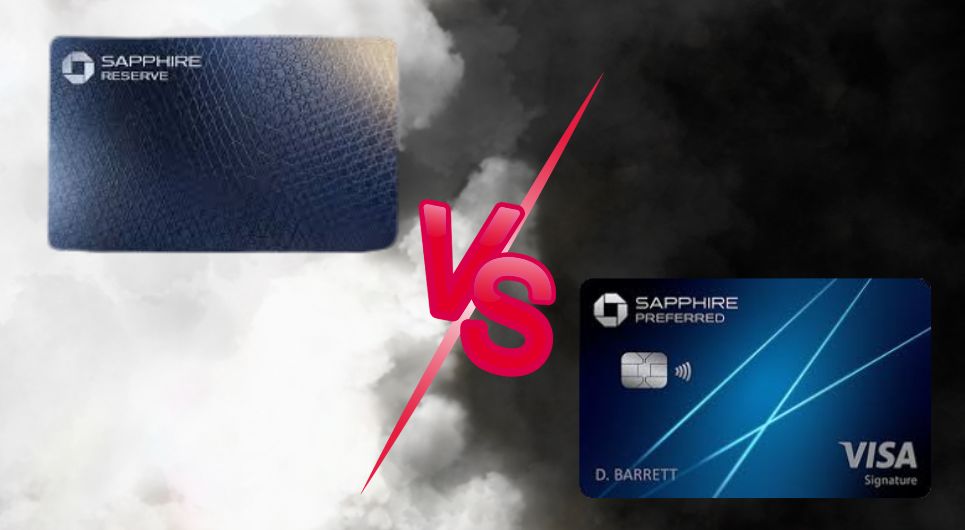
Chase’s Sapphire Preferred® and Sapphire Reserve® cards are popular travel rewards cards that share many similarities.
Both earn Chase Ultimate Rewards points, which are transferable to multiple hotel and airline partners. Both earn bonus points for travel and dining. Both can use rewards to pay for some travel at a better-than-1-cent-per-point value. Both offer excellent travel protections and no foreign transaction fees. Finally, both can make points earned on Chase Freedom® cards and select Chase Ink® cards more valuable because you can move those “cash back” points to your Sapphire Preferred or Sapphire Reserve card to book travel or transfer points to airline and hotel partners.
Last year, Chase launched a drastic reboot of the Sapphire Reserve, with a revised earning structure, oodles of new coupon-like credits, and a jaw-dropping $795 annual fee.
Each card has its pluses and minuses, along with the wildly different annual fees. In this post, you’ll find a side-by-side comparison of each card’s benefits, perks, and travel & purchase protections that will appeal (or not appeal) to different people in drastically different ways.
However, before diving into the details of each card, it’s important to mention that the best card for you right now may very well be whichever one offers the better welcome offer. Later, you can always call Chase to ask about changing to the other card after the first year.
Overview
If there is such a thing as a “classic” credit card, the Chase Sapphire Preferred card is it, and it’s not hyperbole to say that it changed the world of credit card rewards when it was originally launched in 2009. Not only was it novel to have multiple spending-category bonuses, but it also offered the ability to earn flexible Chase Ultimate Rewards points, allowing cardholders to transfer earnings to hotel and airline loyalty programs.
However, when the Sapphire Reserve card debuted several years later, it was clearly a better choice than the Sapphire Preferred for most travelers. It sported 3X rewards on travel and dining, compared to the Preferred card’s 2X earnings in both categories (at the time). The Sapphire Reserve offered cardholders 1.5 cents per point toward travel booked through Chase, compared with 1.25 cents per point on the Preferred card. The Reserve also had a slew of benefits not available to Preferred cardholders, including a Priority Pass membership.
Initially, the Sapphire Reserve cost $450 per year, but the card’s automatic $300 yearly travel credit made it feel more like a $150 card. In this light, the $95 Sapphire Preferred card didn’t fare well by comparison. After all, with only a net $55 per year extra, you could get better perks, better point earnings, and better value for your points.
Things started changing when Chase increased the Sapphire Reserve annual fee to $550, and now up to $795. Now, the Sapphire Reserve is more like a $ 495-per-year card after the $300 rebate, making it substantially more expensive than the Sapphire Preferred. Chase has also increased the Sapphire Preferred card’s dining earnings to 3X, matching the Reserve card’s offer. The new Reserve card’s earnings on flights and hotels have been bumped up to 4X, but as part of that change, the travel category is now limited to just those two types of purchases; all other travel earns a paltry 1X.
Sapphire Reserve and Preferred Current Welcome Offers

Annual Fee & Statement Credits
The Sapphire Reserve card’s annual $300 travel rebate is easy to maximize. It’s hard not to earn it, since all travel purchases made with the card are automatically rebated up to $300 in total. Note that you don’t earn points on that $300 of spend, so the rebate is arguably worth slightly less than $300.
Meanwhile, the Sapphire Preferred $50 hotel rebate isn’t nearly as easy to earn, since it only applies when you book a paid hotel stay through Chase Travel℠. The rates found through the portal may not be nearly as good as what you can obtain through other means, such as with member discounts, AAA discounts, etc. And, finally, when booking hotels through Chase Travel, you usually won’t earn extra rewards by starting in an online shopping portal.
Last year, Chase added a whole bunch of coupons to the revised Sapphire Reserve, all broken up into irritating, bi-annual chunks: $250 twice per year on bookings through Chase’s luxury hotel collection, The Edit; $150 twice per year at StubHub or viagogo; and $150 twice per year when dining at restaurants that are a part of Chase Exclusive Tables. Note that The Edit credit requires a 2-night minimum booking, and you must pre-pay for your stay.
Ostensibly, these credits give Sapphire Reserve cardholders ~1100 per year in value, and for some folks, it will legitimately provide that amount, particularly if there are lots of restaurants in your area that qualify for the dining credit and/or if you regularly buy event tickets from StubHub. If that’s not you, you’re left with the $250 Edit credits that must be used twice per year on two-night stays.
Because the value of these will vary widely from person to person, we’ll refrain from putting an exact dollar amount on them. But it’s worth asking, “Would I buy these every year for $495?”
Card Perks
Below, we’ve listed the perks for each card that we think are the most valuable. For complete details about card perks and more, see our guides to the Chase Sapphire Reserve and Chase Sapphire Preferred.

Here again, the card’s benefits diverge even further. There are undoubtedly more benefits with Sapphire Reserve: lounge access, TSA Pre Check credits, and IHG Platinum status. However, those are all benefits that many of us already get with other cards, and the Sapphire Reserve doesn’t offer anything unique beyond access to Sapphire Lounges (which are very nice).
In terms of earnings, the Sapphire Preferred currently offers better returns on non-flight/hotel travel, streaming, and online grocery. That last category can be particularly helpful, as many readers have found that you can get 3X by paying in a grocery store using that store’s app. In addition, the Preferred also gives you a 10% points bonus every year, effectively adding a 0.1 multiplier to all purchases.
By comparison, the Reserve wins on direct purchases of air travel and hotels, as well as purchases through Chase Travel…but not much else. It’s a shame that Chase chose to narrow what was previously a very expansive travel category into the same flight-and-hotel version that almost every “travel” card has. It makes it much harder to think of it as an “all-around travel card.” By comparison, the Preferred earns only 2x, but it applies to all travel, not just flights and hotels.
For many cardholders, the biggest reduction in the value of the “new” Reserve compared to the old one will be the nerfed ability to use points to book travel through Chase at 1.5 cents per point. Instead, Chase Travel℠ will offer rotating “points boosts” of up to 2x (with occasional promotions that may go higher). All other non-boosted travel redemptions will only provide 1 cent per point in value.
How that compares will depend a lot on the frequency and quality of the points boosts. If they’re widespread, apply to many different types of redemptions that you need, and are usually 1.5X+, it could be a win.
Travel Protections
Both cards offer very good protection for paid travel. However, the Sapphire Reserve is clearly superior:
Purchase Protections
Here are the highlights of the purchase protections that both cards offer. Again, the Sapphire Reserve is clearly superior:
Chase Sapphire Reserve vs Preferred Summary
Conclusion
Undoubtedly, many people will decide that the Sapphire Reserve card’s benefits don’t justify the sizable $795 annual fee. However, some will reasonably decide otherwise. The value proposition of the Sapphire Reserve, with its myriad credits, bears more resemblance to the American Express Platinum Card® than to the Sapphire Preferred.
Here are some reasons why it would make sense to choose the Sapphire Reserve over the Sapphire Preferred:
• The credits for The Edit, StubHub, and Chase Exclusive Tables are useful and easy to optimize
• The majority of your travel bookings are for flights, hotels, or through Chase Travel℠
• You value the Sapphire Reserve card’s Priority Pass benefit (and its ability to get you into Chase Sapphire Lounges)
• You value the Sapphire Reserve card’s better travel protections
If those don’t float your boat, and especially if you don’t find the new credits useful, the Sapphire Preferred is still an excellent way to retain transfers to Chase’s travel partners at a pricetag that’s several hundred dollars lower.
The post Chase Sapphire Reserve® vs Sapphire Preferred® appeared first on Frequent Miler. Frequent Miler may receive compensation from CHASE. American Express, Capital One, or other partners.