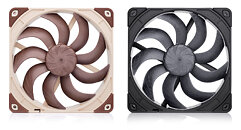
Austrian fan maker Noctua has published a technical blog explaining why it sometimes takes a long time for the company to release the dark-edition chromax.black fans after the initial beige and brown design is out. The company compares the level of engineering required for a new color code to painting a Formula 1 car, rather than a simple color change like you would typically do with a wooden fence. Noctua is known for its scientific testing, rigorous performance evaluations, highly detailed lab experiments, and more, which make its fans worthwhile. This has created a massive fan base within the enthusiast community over the years, who now eagerly await each new product release. When it comes to manufacturing, the company applies that same rigor everywhere, and a simple color change is not taken lightly. For example, Noctua produces its fans using injection molding, where plastic is melted and forced into a steel mold. However, when a new pigment is used, the entire calculation can be disrupted. Noctua designs its fans with high precision to maximize airflow performance. This means that blade impellers have a tip clearance before hitting the fan frame of only a few tenths of a millimeter, about 0.5 mm for 120 mm fans and about 0.7 mm for 140 mm fans. Introducing any third-party pigment into this process could disrupt the structure of this fan tip clearance and potentially interfere with Noctua's Sterrox liquid-crystal polymer (LCP) material used in its fans. Specifically, color pigments have particles that directly affect how the injection mold behaves, as they carry their own particle imperfections. This negatively impacts the hundreds of thousands of performance tests that Noctua conducts in the lab and significantly delays the chromax.black product launch.