
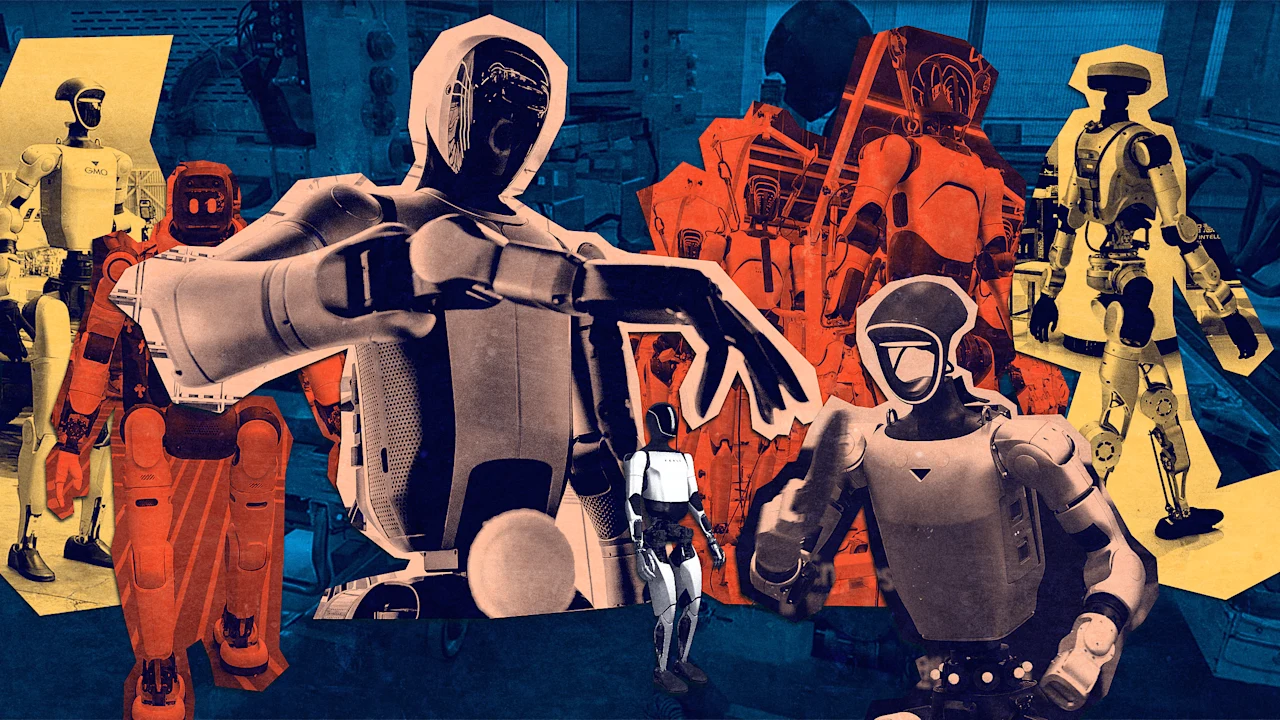
In December 2025, the biggest battery maker in the world, CATL, started what it calls the world’s first large-scale deployment of robots in its Luoyang, China factory. Last week, the State Grid Corporation of China began its $1 billion 2026 plan to deploy a humanoid army to maintain its grid autonomously. And just a few days ago, at the other side of the East China Sea, Japan Airlines announced the beginning of a test program of humanoids to carry luggage at airports.
While we listen to Elon Musk tell us how magical and civilization-changing Tesla’s Optimus robots are, Asian countries are light-years ahead of us, deploying humanoids to do their bidding in real-life scenarios.
There are two main reasons humanoids are happening much faster in Asia than in the U.S. or Europe. One of the reasons is purely economic: China is always looking at cost optimization.
For years, industrial robotics has been a main driver in the country’s quest to reduce manufacturing prices and times. China’s dark factories, where fully automated robots churn out devices with the lights off because they don’t need them, are famous.
“China is by far the world’s largest robotics market in 2024. It represents 54% of global deployments. The latest figures show that 295,000 industrial robots have been installed in the country, the highest annual total on record,” says the International Federation of Robotics in its World Robotics 2025 Report.
So humanoids—bipeds or wheeled—are the logical next step. This is especially true as AI models begin to understand the world, and companies realize that a huge market awaits for general and specialized tasks that only human-like robots can properly do.
The other reason is demographic: Japan’s population is quickly getting older, while in China, fewer people want to do hard and dangerous work like maintaining power grids.
Japan became the world’s first “super-aged” society back in 2006, and as of 2026, over 30% of its population is aged 65 or older. The country’s total population is currently shrinking by nearly one million people per year. The sheer lack of young, able-bodied workers makes manual labor roles in logistics and aviation impossible to fill, forcing the country into reliance on machines.
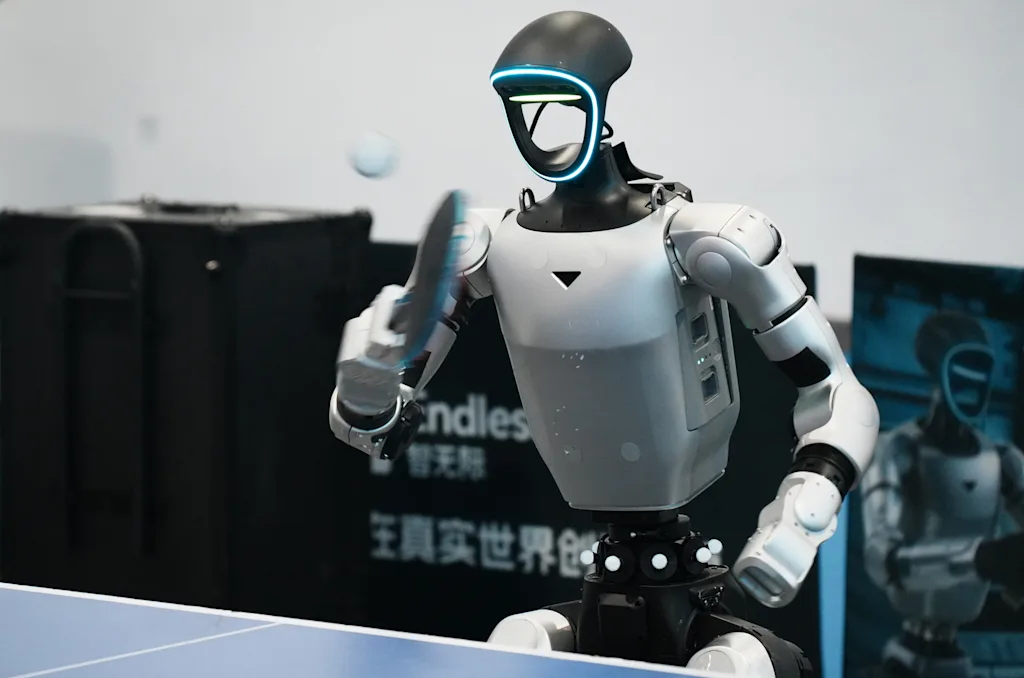
In China, the issue is slightly different, but equally pressing. While China has a massive population, its traditional blue-collar workforce is aging out. An estimated 300 million migrant workers—the people who physically built the country’s modern infrastructure and power grids over the last four decades—are now approaching retirement age.
Younger generations are simply not stepping in to replace them in highly dangerous roles, like maintaining live 10,000-volt power lines. Facing a critical workforce shortage in the trades, China has chosen to deploy robotic electricians that operate 50% faster than human crews with a 98% success rate.
Business and political drive
At the same time, China and Japan have the means and the willpower to make this happen. The former controls the majority of the global supply chain to make humanoids—and robots of any kind—in huge quantities. Meanwhile, the U.S. can’t even produce magnets—a key component to robotics—without reliance on its rival.
Japan, with its aging population in mind, has been working on robotics for years and now is making the jump from small deployments in hospital facilities to large-scale industrial deployment of humanoids. The country’s move into aviation logistics is born of sheer demographic desperation. According to The Guardian, the country will require more than 6.5 million foreign workers by 2040 just to hit its economic growth targets, but it faces intense political pressure to limit immigration.
The solution is mechanical. Starting this May, a 130-centimeter-tall humanoid manufactured by the Chinese company Unitree will begin hauling passenger luggage and cargo on the tarmac of Haneda airport, a massive hub that handles over 60 million passengers annually. These units can operate continuously for two to three hours.
Tomohiro Uchida, President of GMO AI and Robotics—which is collaborating on the pilot alongside JAL Ground Service—says that while airports look highly automated, “their back-end operations still rely heavily on human labor and face serious labor shortages.”
While Japan is testing the waters to plug a gaping demographic hole, China is diving headfirst into mass industrialization. The State Grid Corporation of China has allocated 6.8 billion yuan (roughly $1 billion) to purchase approximately 8,500 robots this year alone.
While that order includes 5,000 quadruped robot dogs to examine power lines in mountainous terrain, they are actively introducing humanoid and dual-arm models to execute dangerous maintenance duties on the ultra-high-voltage grid. Across all Chinese utility companies, spending on AI robotics is projected to exceed 10 billion yuan in 2026.
The growth of embodied AI is about to explode in the Asian country—with total output in China reaching 2.1 million units by 2030—says Zheshang Securities. It’s only the beginning of the future, as the financial firm describes: “We believe 2026 will be the year humanoid robots achieve mass production. The future has arrived.”
A robotic army marches towards automation
That future is already clocking in at CATL’s Zhongzhou facility. Operating via a Vision-Language-Action AI model, robotics company Spirit AI’s Xiaomo humanoids visually identify shifted plug positions and instantaneously correct their grip to connect high-voltage battery components with a 99% success rate.
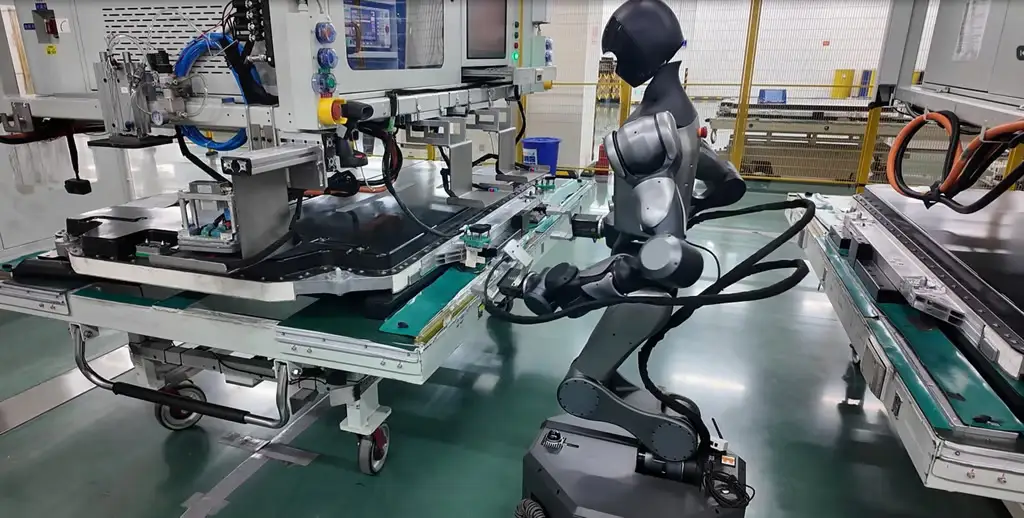
Not only is this a dangerous task for human operators—who obviously don’t want to get electrocuted—but, because they don’t take breaks, a single humanoid handles a daily workload three times larger than a human employee.
CATL is not alone in this industrial shift. A massive ecosystem of highly funded, specialized manufacturers is fueling these deployments. Unitree Robotics—the Hangzhou-based firm supplying Japan Airlines—recently completed its Series C funding, pushing its valuation past $1.6 billion. The company recorded over 5,500 shipments in 2025 and recently filed for a $610 million IPO on the Shanghai Stock Exchange to aggressively scale manufacturing.
AgiBot is another purely-robotic play in China. Founded in 2023, the Shanghai-based company shipped over 5,100 humanoid robots in 2025 alone, securing the number one spot globally in both humanoid shipment volume and market share. By early April 2026, AgiBot officially rolled its 10,000th unit off the production line, cementing its position as the undisputed global leader in commercial humanoid manufacturing.
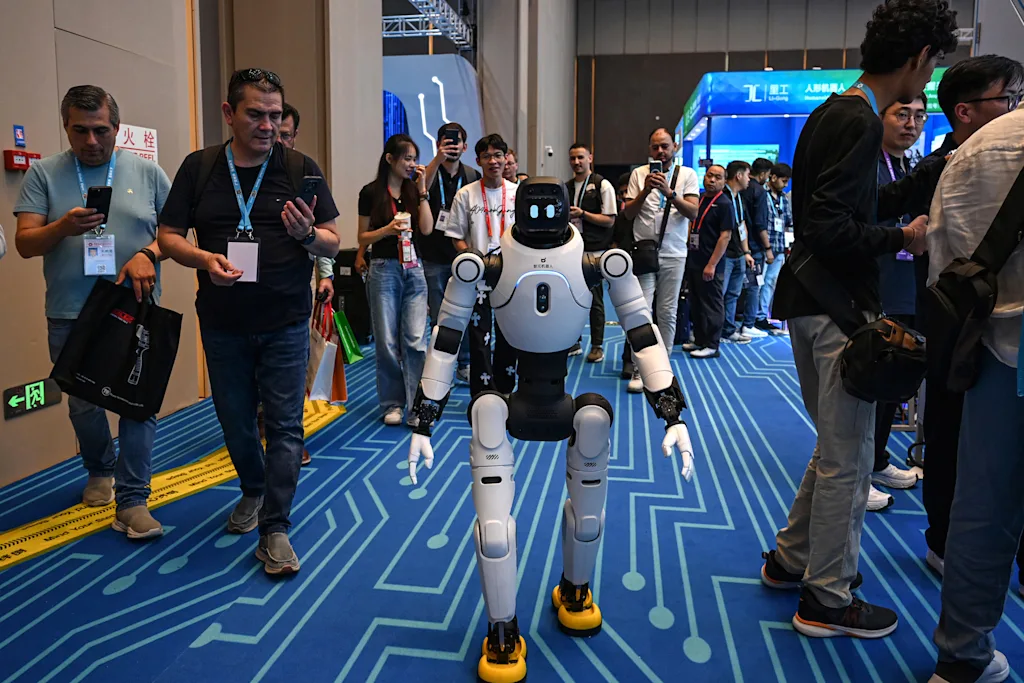
For context, American counterparts like Figure AI, Agility Robotics, and Tesla shipped a fraction of the Chinese humanoid industry numbers.
Same with Ubtech Robotics, which has introduced its Walker S2 industrial humanoid. It features an autonomous battery swapping system that allows it to operate continuously. Ubtech reported a staggering 2,200 percent surge in full-size humanoid robot revenue in 2025, successfully hitting its target of delivering 500 units by year’s end, and actively placing hundreds on the factory floors of BYD, Geely, and Foxconn. Ubtech has amassed cumulative orders exceeding 1.4 billion yuan and is currently scaling its manufacturing capacity with a target of 10,000 units annually.
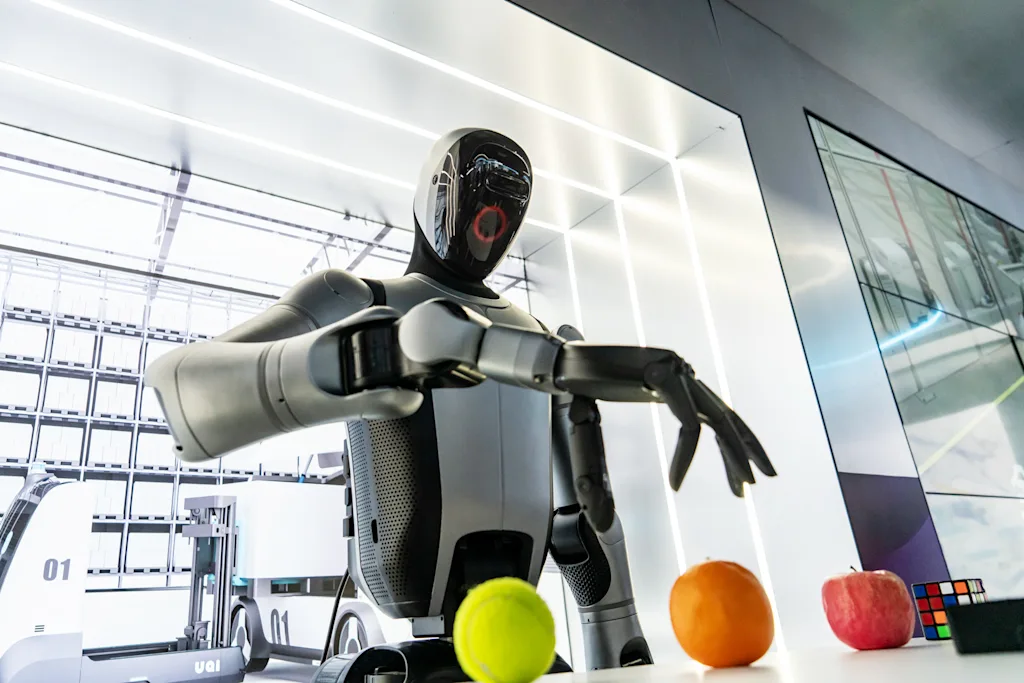
But the humanoid push doesn’t stop at these specialized robotic startups. Other tech and car brands are quickly pivoting to embodied AI as well. Xpeng just broke ground in the first quarter of 2026 on a 1.2 million-square-foot production facility in Guangzhou that will build its viral Iron humanoid robots by year’s end.
Xiaomi is embracing robotics, too. Its CEO Lei Jun recently announced that the company’s humanoids have successfully completed autonomous trial operations on their EV assembly lines, maintaining a 90% success rate when installing self-tapping nuts on car floors within a 76-second window. Xiaomi plans to deploy these machines in large numbers across its production facilities by 2030.
Supply chain and more
China is clearly ahead and that’s because, in addition to having the political and economic will, they have the manufacturing power to make it happen. The same reason why American giants like Tesla will struggle to compete with this robotic army that Beijing is pushing full steam ahead: China fully dominates the supply chain.
The center of which is in Shenzhen, a hyper-concentrated manufacturing hub that acts as the world’s primary robotics forge. By the end of 2025, Shenzhen manufactured nearly 8 million service robots—a broad category that includes logistics bots, cleaners, and the foundation for more complex humanoids.
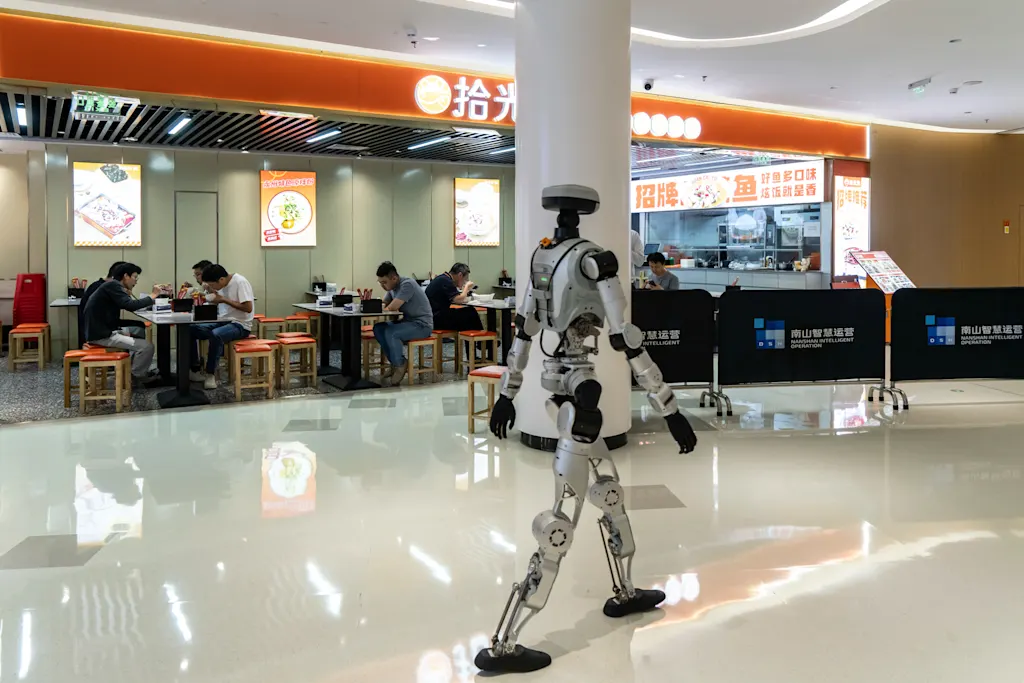
This staggering volume accounted for 43% of China’s total national output, pushing the city’s robotics industry value past $35.4 billion. Yang Qian, the chief operating officer of X Square Robot, says that this local supply chain advantage means “custom parts can be delivered in days, compared with months overseas.” He adds that iteration costs in Shenzhen are “only a tenth of those abroad.”
American manufacturers are currently choking on their lack of a domestic supply chain. It’s not only that the Chinese have more experience and manufacturing power. You only have to focus on one of many critical bottlenecks: rare-earth magnets.
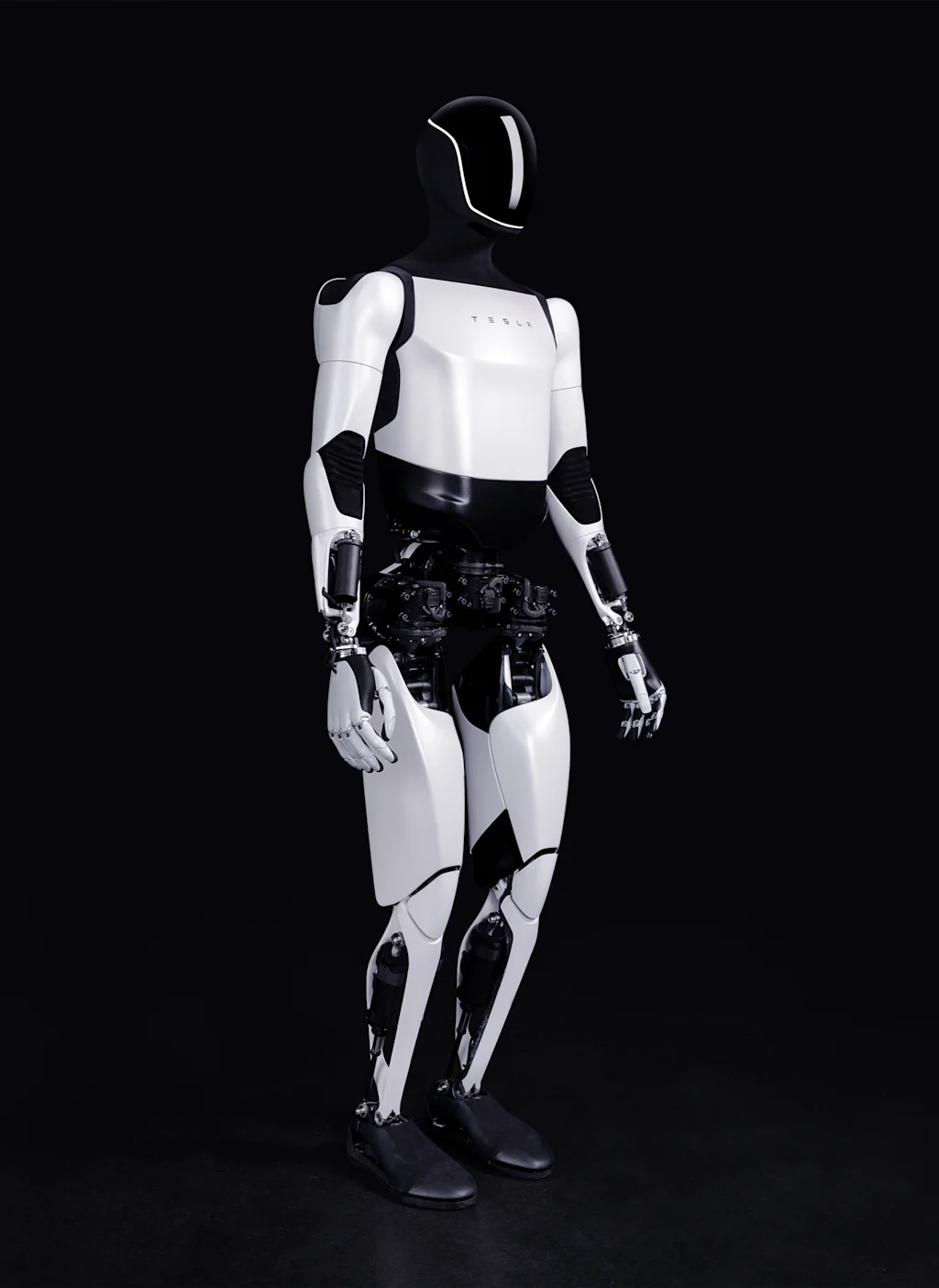
A single Tesla Optimus humanoid requires up to eight pounds of Neodymium-Iron-Boron magnets to power its 40-plus servo motors. When Beijing halted exports of these materials on April 4, 2025—after Trump started his tariff war against China—Optimus production hit a brick wall.
Anonymous sources within the Optimus supply chain confirmed to AInvest that Tesla capped its inventory at roughly 1,000 units, stating that with the procurement freeze, Musk’s goal of producing 5,000 units this year is “now largely unattainable.”
In a recent podcast recorded at Nvidia’s GTC event in San Jose, CEO Jensen Huang warned that the U.S. robotics industry will be forced to rely on China.
“I think China is formidable,” Huang said. “The reason for that is because their microelectronics, motors, rare earth and magnets—which are foundational to robotics—are the world’s best. So in a lot of ways, our robotics industry relies deeply on their ecosystem and their supply chain.”
Huang added that, while the U.S. practically invented robotics, then the country got “tired and exhausted” waiting for the necessary AI “brain” technology to emerge, allowing China to seize the manufacturing advantage.
The problem is that, while the U.S. government is frantically trying to prop up a domestic magnet supply chain through companies like MP Materials, China is also advancing in the AI models that humanoid robots use, matching and even surpassing its American counterparts.
If Washington and Silicon Valley don’t spend more money in becoming independent from China as fast as possible, America will be stuck watching Elon Musk’s home videos while China actually builds the robotic workforce of the future to solve real problems, today.