construction advances along the coast of norway
New images document the construction of The Whale by Dorte Mandrup in Andenes, Norway, showing the building emerging directly from its Arctic shoreline.
The building, with its low rooftop, reads from above as a low, continuous form pressed into a chain of rocky islets. Its footprint follows the contours of the terrain and extends toward the water without asserting a clear boundary between land and ocean. A red lighthouse and the clustered houses of Andenes remain visible in the background to reinforce the scale of the intervention within a working coastal town.
image © Terje Løkke
the whale: a gestural surface shaped by climate
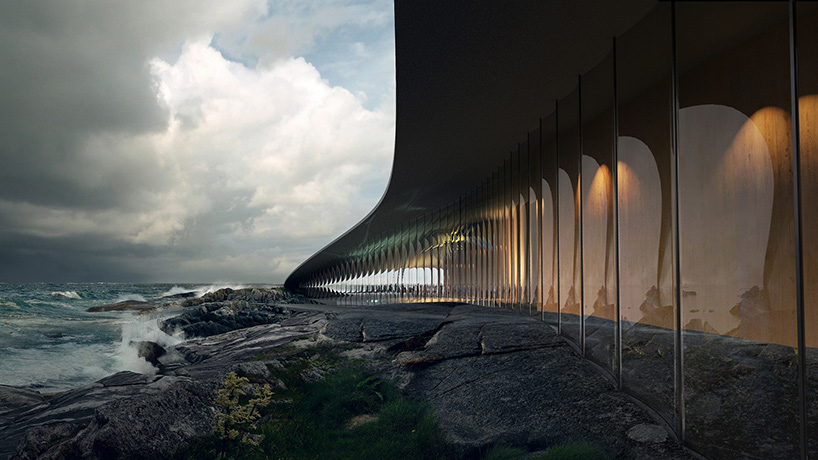
The defining gesture of The Whale by Dorte Mandrup is its broad, curved rooftop which peels away from the landscape of Norway. This sculptural structure is now legible in steel and concrete. A series of ribs trace the arc of the surface, revealing how the geometry is being built up in layers. The form dips toward the ground at its edges, touching down lightly at several points while spanning across the interior volume.
This roof will eventually be clad in locally sourced stone, laid in an irregular pattern that echoes the surrounding shoreline. Even in its unfinished state, the intention is clear. The building is conceived as a continuation of the terrain, with a surface that can be walked, crossed, and experienced as landscape rather than object. The slope also addresses the realities of snow accumulation in northern Norway, allowing precipitation to move across the surface rather than settle.
visualization © Mir
dorte mandrup orients interior spaces toward the sea
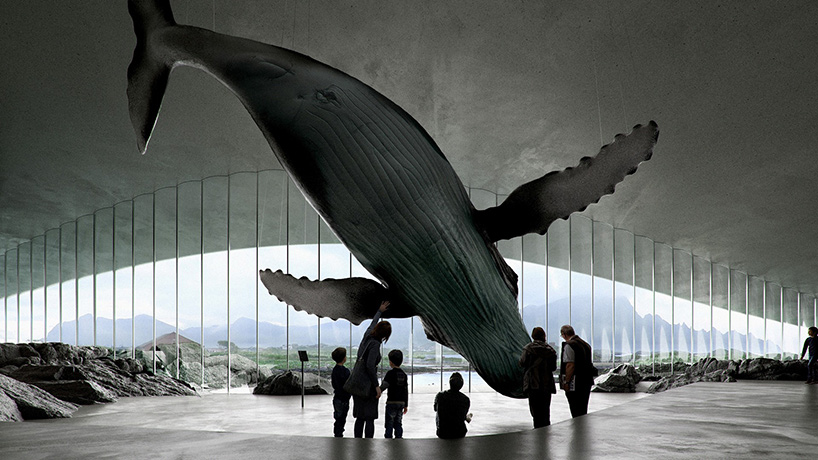
Inside, the project is organized around a sequence of open exhibition areas facing the water. Rendered views and early interior photographs indicate a restrained palette, where concrete floors, soft daylight, and timber elements define the atmosphere. Large panes of glazing run along the perimeter, framing views of the archipelago and the Norwegian Sea beyond.
Furniture and displays are integrated at a low height, keeping sightlines open. Whale-inspired forms appear in seating and exhibition pieces, shaping how visitors move and gather. The space is conceived as both a place of learning and a vantage point, where the act of looking outward toward the ocean becomes part of the exhibition itself.
image © Terje Løkke

architecture linked with landscape and migration routes
The Whale is positioned near Bleiksdjupa, a deep-sea canyon that brings marine life close to shore. This proximity informs the project at every level, from its orientation to its program. The building will house exhibitions, a café, and research-oriented content focused on marine ecosystems, connecting human presence on land with the activity occurring offshore.
As construction progresses, the relationship between building and site becomes increasingly precise. The edges align with existing rock formations, and access paths extend across the terrain rather than cutting through it. The project by Dorte Mandrup approaches its setting with a directness that comes through clearly in these new images, where the structure is already beginning to register as part of the coastline it occupies.
image © Terje Løkke

visualization © Mir

project info:
name: The Whale
architect: Dorte Mandrup | @dorte_mandrup
location: Andenes, Norway
collaborators: Marianne Levinsen Landskab, JAC Studio, Thornton Tomasetti, AT Plan & Arkitektur
The post dorte mandrup’s sinuous center ‘the whale’ takes shape along norway’s arctic coastline appeared first on designboom | architecture & design magazine.