INTERNATIONAL. UK aviation and travel retail forecasting, analysis and research service Air4Casts has painted a stark contrast between China’s and India’s international airports in the first full month following the US and Israel attack on Iran.
“The trigger was immediate,” the company writes in an introduction to its excellent latest Air4casts Travel Retail Brief*. “US and Israeli airstrikes on Iran on 28 February forced Gulf airspace closures and wiped out more than 21,000 flights across seven major hubs in just four days.
“But the real story lies in the aftermath. A month on, the preliminary March traffic data tells a sharper, more uneven story. The countries with the deepest exposure to the Gulf travel corridor are the ones now showing the biggest declines – and almost no-one is more exposed than India.
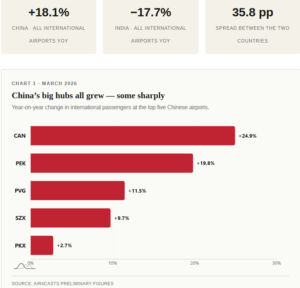
“The contrast with mainland China could hardly be starker. While India’s top international gateways posted year-on-year passenger declines ranging from a slight dip to almost a quarter, China’s big five hubs all grew, several of them at double-digit rates.”
Why the severe hit in India? Simple, Air4Casts explains. The Gulf is India’s biggest international market – by a long way
“India’s exposure to the Middle East is structural, not incidental,” the report observes. “According to IATA’s 2024 analysis of the Indian aviation market, the United Arab Emirates alone accounts for 19.9% of all international origin-and-destination passenger traffic to and from India – some 7.6 million journeys in 2024. Saudi Arabia adds another 9% share. By way of comparison, the second-largest country market, the United States, sits at just 9.2%.”
Air4Casts cites OAG data, which underlines the same dependence in capacity terms. In March, 27% of India’s international seat capacity was on UAE routes, and four of the country’s top ten international routes were India–Middle East-based. Mumbai–Dubai is India’s single busiest international route, with 237,000 monthly seats. “When the Gulf coughs, Indian aviation catches pneumonia,” Air4Casts notes.
Following Iran’s retaliation and the closure of the Strait of Hormuz, Dubai, Zayed, Hamad, Bahrain, Kuwait international airports and other Gulf hubs spent much of early March either closed or operating well below capacity.
Air India suspended all of its Middle East services, the report points out. IndiGo and SpiceJet rerouted what they could and cancelled the rest. India’s Civil Aviation Authority designated the airspace over Jordan, Saudi Arabia, Lebanon and the wider Gulf as high-risk at all altitudes.
On 16 March a blanket suspension of departures and arrivals at DXB diverted at least nine Air India services to Dubai World Central or back to their points of origin. Industry sources cited by regional press estimated the corridor normally handles around 1,000 India-linked passenger movements per hour.
Other key points in the Air4Casts report
Blue-collar worker decline
• Migrant workers, not tourists, drove much of India’s loss. The economic geography of the India–Gulf corridor matters here. A large share of those passengers are not leisure travellers but Indian workers heading to construction, hospitality and service-sector jobs in the GCC, plus the families and remittance flows that go with them.
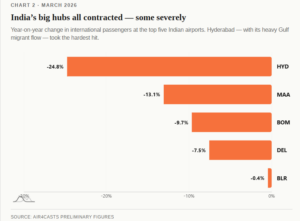
• The pattern in the data follows the labour geography. Hyderabad, with its especially heavy Telangana–Gulf migrant flow, posted the steepest fall — nearly −25% year-on-year. Chennai was next at -13% but Kempegowda International Airport Bengaluru, where international traffic skews more towards tech-business travel to Europe and North America, was barely affected at −0.4%.
Why China kept flying
• The Gulf simply isn’t a major destination for Chinese travellers.
• Air4casts is currently forecasting nearly 64 million mainland Chinese travellers who will take an international flight out of the mainland in 2026. The top three destinations, in order, are Thailand, Hong Kong and South Korea with former leader Japan now well down the list because of the current tensions between the two countries.
• None of them require routing through the Gulf, none were affected by the airspace closures, and all are within four hours’ flying time of major Chinese hubs.
• For Qingming Festival travel at the end of March and early April, Chinese online travel agency Fliggy reported the most-booked outbound destinations were the Philippines, Thailand, Singapore, Malaysia and South Korea. Travel groups reported outbound bookings up roughly 30% year on yearfor the holiday period.
• Visa-free tailwind: From 1 March 2026, China extended visa-free entry to American, British and Irish passport holders, taking the total number of eligible nationalities to 54.
• The three biggest mainland gateways — Beijing Capital, Shanghai Pudong and Guangzhou Baiyun — are precisely the airports designated to process those visa-free arrivals at accelerated rates.
• The Chinese Yuan has appreciated more than 1% against the US Dollar since December. Add in mutual visa-free agreements with Thailand and Singapore, and an unusually long Lunar New Year break that pulled bookings forward into the early-spring window, and you have a structural backdrop in which March overseas travel through Chinese hubs was always likely to grow strongly – with or without a Gulf war making the comparison flattering, Air4Casts says.
Air4Casts’s aggregate picture
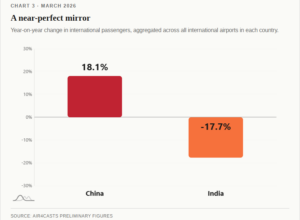
Aggregating across all international airports in each country, not just the top five, the contrast becomes a near-perfect mirror: China up +18.1%, India down -17.7%, a spread of almost 36 percentage points in a single month.
“It is rare to see two of the world’s largest aviation markets diverge this sharply, this quickly, off the back of a single geopolitical shock,” the report concludes.


About Air4casts
Air4Casts was established in 1990 by a small group of marketing, consulting and systems professionals to offer a unique forecasting, analysis and research service for the asviation and travel retail sectors.
Today Air4casts is run by a team of highly-qualified and multi-lingual specialists with 30 years’ experience. It advises multiple industry stakeholders, including companies from every brand product category.